How a carefully measured dose of energy prompts the skin to rebuild its own collagen, and why the results keep developing for months after treatment.
Regenerative aesthetics is an approach to skin rejuvenation built on the body’s own capacity for repair. A provider delivers a precise amount of energy into the skin, enough to set off a healing response, and the skin’s own cells then produce the fresh collagen and elastin behind the visible change.
The science is older than most people expect. Its foundation was laid in the early 1980s at Massachusetts General Hospital, where dermatologists worked out how a pulse of light could heat one microscopic target while leaving the skin around it unharmed. Nearly every laser and pulsed light device used in medical aesthetics today traces its design back to that work.
At Freya’s Laser & Body Sculpting in Prescott, that regenerative philosophy shapes which technologies we bring in and how we plan each treatment. This guide explains the biology behind energy-based renewal and how each form of energy puts it to work.
What is regenerative aesthetics?
Regenerative aesthetics is a branch of aesthetic medicine that improves the skin by stimulating its natural repair processes. Treatments in this category introduce controlled energy or biologically active material into the skin, which signals cells called fibroblasts to rebuild the structural proteins that keep skin firm and smooth.
The field draws on two main toolsets. Energy-based devices, including lasers, broadband light, radiofrequency and plasma, create a measured thermal or photochemical effect in the tissue. Biologic treatments such as Cellenis Derma PRP in Prescott supply concentrated growth factors that support the same repair pathways. This article focuses on the first group, which forms the backbone of most regenerative skin programs.
The approach is defined by its timeline. Because the skin does the rebuilding, improvement continues long after the appointment, typically maturing over three to six months as new collagen settles into place. Results also tend to look natural for a simple reason, since the new support structure is made from the patient’s own tissue.
How does controlled energy prompt the skin to repair itself?
Skin responds to injury through a well-documented sequence known as the wound healing cascade. Energy-based treatments create a small, deliberate version of that injury, measured in microns and in fractions of a second, and the skin answers by running its full repair program.
What happens in the first days after treatment?
The first phase is inflammation, and it begins within hours. Heat-stressed cells release signaling molecules called cytokines, and the skin produces heat shock proteins, protective molecules that help cells survive thermal stress and are closely tied to collagen production. Blood flow to the treated area increases, which accounts for the warmth and pinkness most people notice after a session.
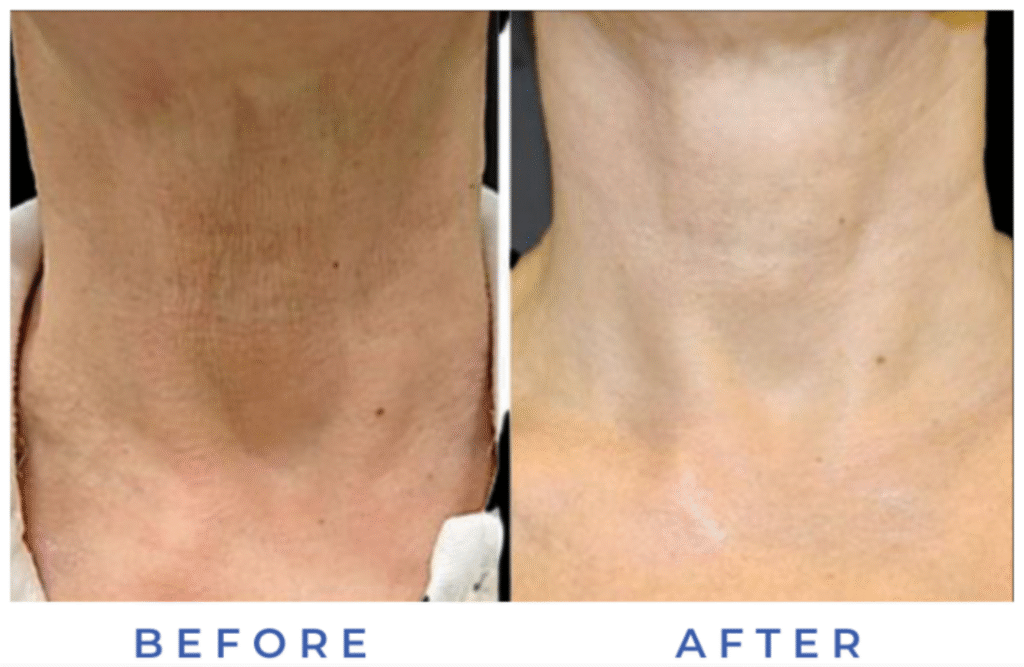
Within days, the proliferative phase takes over. Fibroblasts multiply and move toward the treated zones, where they begin producing procollagen, the building block of mature collagen. At the surface, skin cells divide quickly to replace those that were cleared, which is why the complexion often looks brighter within the first week or two.
Why does new collagen take months to appear?
Remodeling, the final phase, is also the slowest. Enzymes called matrix metalloproteinases break down old, fragmented collagen, and fibroblasts lay down a new network in its place. The earliest new collagen is mostly type III, a finer and more flexible form, and the body gradually replaces it with sturdier type I collagen. That exchange runs on the body’s own schedule, so firmness and texture keep improving well after any visible recovery has ended.
Researchers have measured the early stages of this response directly in treated skin.
84% In a University of Michigan study of photodamaged skin, a single nonablative 1320 nm laser treatment raised type I procollagen gene activity 84 percent above baseline one week later. The researchers also recorded rises in type III procollagen and other markers of dermal remodeling, while noting that individual responses varied widely from patient to patient. Source: Orringer JS, et al., Journal of the American Academy of Dermatology, 2005 |
That variability is one reason a provider tailors settings to each person’s skin, and it helps explain why most regenerative plans involve a series of sessions.
What is selective photothermolysis, and why does it matter?
Selective photothermolysis is the principle that allows light to heat one target in the skin while sparing the tissue around it. Dermatologists R. Rox Anderson and John Parrish described it in the journal Science in 1983, and it remains the foundation of modern laser medicine.
The principle depends on two variables. The first is wavelength. Each light-absorbing structure in the skin, known as a chromophore, absorbs certain wavelengths far more readily than others. Melanin in a sunspot and hemoglobin in a small vessel each respond to their own ranges of visible light. Water, which makes up most of the skin’s volume, absorbs longer infrared wavelengths, and tattoo ink absorbs according to its color.
The second variable is pulse duration. When a pulse is shorter than the time a target needs to release its heat, a span called the thermal relaxation time, the heat stays concentrated where it belongs. Pairing the right wavelength with the right pulse length lets a provider break up pigment or collapse a vessel without injuring the surrounding skin.
That precision made energy-based rejuvenation safe enough for routine clinical use. It also explains why skin type matters so much in light-based care, since melanin in the surrounding skin competes with the intended target for the same energy.
Why did fractional treatment change the field?
Fractional photothermolysis is a method of treating the skin in a grid of microscopic columns, with bridges of untouched tissue left between them. A Harvard team led by Dieter Manstein and Rox Anderson introduced the concept in 2004, and within a few years it had reshaped laser resurfacing.
Earlier resurfacing lasers removed the entire surface layer in one pass. Results could be dramatic, although healing took weeks and the risk of complications was considerable. Fractional devices treat only a portion of the surface with each pass, and the intact skin between the columns supplies healthy cells that move in and close each microscopic wound quickly.
Why the untreated skin matters Healthy tissue left between treatment columns acts as a reservoir for repair. Cells from those bridges repopulate each treated zone at the surface quickly, while the deeper collagen response continues for months. The arrangement lets a provider reach meaningful depth with far less downtime than full-surface resurfacing once required, and it is the reason modern resurfacing fits into a working schedule for most people. |
The same logic now extends well beyond lasers. RF microneedling, for example, places heat in a fractional pattern through fine needles and leaves healthy tissue between each treatment point.
Which forms of energy power regenerative treatments?
Each energy source reaches the skin through a different mechanism, and that mechanism largely decides which concerns it treats best.
How does broadband light correct color?
Broadband light uses a filtered spectrum of visible and infrared light to target melanin and hemoglobin. The absorbed heat breaks up pigment clusters and collapses small vessels, and gentle warming of the dermis supports collagen activity across a series of sessions. BBL HEROic in Prescott adds motion tracking that places each pulse automatically, keeping coverage even across larger areas such as the chest and back. We covered that technology in depth when bringing BBL HEROic to Prescott for our five-year anniversary.
What do fractional lasers renew?
Fractional lasers target water in the tissue, which makes their effect far less dependent on pigment than broadband light. Ablative fractional lasers, such as fractional erbium, vaporize microscopic columns of tissue and produce the strongest resurfacing effect. Nonablative settings heat the tissue without removing it, which shortens recovery while still prompting renewal. Our laser skin resurfacing in Prescott uses fractional erbium technology, and NOUVADerm laser resurfacing in Prescott uses a thulium laser that moves between gentler nonablative settings and more intensive ablative ones.
How does radiofrequency rebuild deeper support?
Radiofrequency is electrical energy that heats tissue through resistance as current passes through it. Its effect does not rely on light absorption, so skin color has little influence on how it behaves, which makes it one of the safer energy options for deeper skin tones. RF microneedling carries that energy below the surface through fine needles and releases heat directly into the dermis, where firmness is built. Our RF microneedling in Prescott includes Scarlet SRF for broad tightening and Agnes RF for precision contouring along the jawline.
What does plasma contribute?
Plasma is ionized gas, a state of matter in which energized particles can carry controlled heat to the skin. Nitrogen plasma warms the dermis to stimulate collagen, while argon plasma works at the surface through a photochemical effect that calms bacteria and inflammation. PLADUOpro plasma skin tightening in Prescott pairs both gases in one device, and our article on how plasma skin tightening works explains the physics in more detail.
Non-thermal LED light sits at the gentle end of the range. It supports repair through a process called photobiomodulation, in which light is absorbed by components inside the cell without heating the tissue, and it often serves as a recovery add-on after more intensive work.
The table below summarizes how the main energy sources compare.
Energy source | What absorbs or carries it | Where it works best | Typical social downtime |
|---|---|---|---|
Broadband light | Melanin and hemoglobin | Surface pigment and superficial vessels | A few hours of flushing, with spots flaking off over about a week |
Fractional laser | Water in the tissue | Epidermis into the upper dermis | A few days to about a week, longer at ablative settings |
RF microneedling | Tissue resistance to electrical current | Mid to deep dermis | Usually one to two days of mild redness |
Plasma | Ionized nitrogen or argon gas | Surface with argon, dermis with nitrogen | Little to none with argon; about 7 to 10 days of bronzing with nitrogen |
LED phototherapy | Light-sensitive components within cells | Surface and upper dermis | None |
Why do providers combine energy types?
Photoaging affects more than one layer of skin at once. Pigment and broken capillaries sit near the surface while collagen loss happens deeper in the dermis, and a device aimed at one level leaves the other largely unchanged. Combination protocols close that gap by giving each energy source the job it performs best.
Sequencing matters as much as selection. Light-based color correction generally comes first, while the surface is undisturbed, and deeper or resurfacing passes follow. Spacing matters too, because the skin needs time to move through one healing cycle before the next one begins.
Brisingamen Pro skin regeneration in Prescott is our most complete example, uniting BBL HEROic, Scarlet SRF, PLADUOpro and NOUVADerm in a single coordinated protocol. Many clients start with an Aura 3D skin analysis in Prescott, which maps pigment and vascular activity beneath the surface and helps us decide which energies belong in the plan.
Which concerns respond well to energy-based renewal?
Regenerative treatments work on the skin’s underlying structure, so they suit concerns rooted in collagen loss and accumulated sun damage. Common reasons clients ask about them include:
- Brown spots and uneven tone left by years of sun exposure
- Persistent redness and visible capillaries across the cheeks and nose
- Fine lines and crepey texture around the eyes and mouth
- Early softening along the jawline and neck
- Acne scarring and enlarged pores
Deep folds or advanced sagging may call for a more structural plan, and your provider will say so plainly at consultation if another route would serve you better.
How does the Arizona sun factor in?
Prescott sits roughly a mile above sea level, and ultraviolet intensity rises with elevation. Pair that with the long outdoor season in Yavapai County, and cumulative photodamage becomes the main driver of visible aging for many of our clients. UV exposure breaks down existing collagen and slows the production of new collagen, so the sun works directly against the process regenerative treatment sets in motion.
Sun exposure also shapes treatment timing. Light-based devices cannot reliably distinguish a fresh tan from a sunspot, so an active tan usually means rescheduling. After treatment, daily broad-spectrum sunscreen does more to protect results than any single product in a skincare routine.
What does recovery look like?
Recovery tracks with the energy source and the intensity your provider selects. A light pass of broadband light may leave nothing more than a flush, while ablative resurfacing or nitrogen plasma asks for a week or more of visible healing. Across nearly all energy-based treatments, though, the biology follows a similar arc.
How energy-based renewal unfolds Days 1 to 3: Warmth and mild swelling as the inflammatory phase peaks. Days 4 to 14: The surface renews. Treated pigment flakes away and any bronzing sheds, revealing a brighter, more even tone. Weeks 4 to 8: Fibroblasts produce new collagen, and texture and pore size begin to refine. Months 3 to 6: Remodeling matures as sturdier type I collagen replaces the early framework, bringing the fullest firmness of the treatment. |
Most clients complete a short series of sessions spaced several weeks apart, so each round of remodeling can build on the last. Maintenance visits once or a few times a year help offset the collagen the skin keeps losing with age.
Who is a good candidate, and what should you mention first?
Energy-based renewal suits adults with sun damage or early laxity who prefer gradual, natural-looking improvement over a dramatic overnight shift. Radiofrequency and plasma work across all skin types, and light-based treatments can be adjusted or substituted for deeper skin tones. Before booking, it helps to let your provider know about:
- An active tan or recent intense sun exposure
- Pregnancy or breastfeeding
- Recent isotretinoin use or any photosensitizing medication
- A history of cold sores, which can flare after facial treatment
- Keloid scarring or slow wound healing
The takeaway
Regenerative aesthetics rests on a principle dermatology has refined for more than forty years. A precisely aimed dose of energy creates a controlled injury, and the skin responds by building new collagen of its own. The right technology depends on where your concern sits, at the surface or in the deeper support layers, and the strongest results usually come from a plan that respects the skin’s healing timeline.
If you would like to know which energy-based treatments fit your skin, schedule a consultation at Freya’s in Prescott and we will walk through the options in person.
Regenerative skin treatments at Freya’s Consultations are open at our Prescott location on Commerce Center Circle. Every plan begins with a close look at your skin and your history of sun exposure, so the technologies we recommend are matched to what your skin actually needs. |
Book your consultation in Prescott, Arizona
See what energy-based renewal has done for skin that has spent years in the Arizona sun. Browse real client results in our before-and-after gallery, then schedule your complimentary consultation at Freya’s Laser & Body Sculpting and we will build your plan together.
References
Anderson RR, Parrish JA. “Selective photothermolysis: precise microsurgery by selective absorption of pulsed radiation.” Science, 1983;220(4596):524-527. pubmed.ncbi.nlm.nih.gov/6836297
Manstein D, Herron GS, Sink RK, Tanner H, Anderson RR. “Fractional photothermolysis: a new concept for cutaneous remodeling using microscopic patterns of thermal injury.” Lasers in Surgery and Medicine, 2004;34(5):426-438. pubmed.ncbi.nlm.nih.gov/15216537
Orringer JS, Voorhees JJ, Hamilton T, et al. “Dermal matrix remodeling after nonablative laser therapy.” Journal of the American Academy of Dermatology, 2005;53(5):775-782. doi.org/10.1016/j.jaad.2005.07.052